Duolingo vs TalkPal: A Complete Language App Comparison Guide
Language learning apps continue to experience explosive growth.
Recently, millions of learners around the globe are turning to mobile platforms to pick up new languages faster and more conveniently than ever before.
Two of the most popular contenders in this space—Duolingo and TalkPal—have taken very different approaches to help users reach fluency.
Duolingo, the long-time champion of gamified learning, serves over 500 million learners worldwide with its bite-sized lessons and colorful, addictive interface.
TalkPal, on the other hand, is a newer AI-powered platform that focuses on natural conversation practice and immersive communication training.
With so many language apps available, a growing number of users are asking a key question: Duolingo vs TalkPal — which is more effective?
In this comprehensive comparison, we’ll explore exactly that, evaluating both through feature lists, pricing, learning effectiveness, and ideal use cases for all types of language learners.
🔍 Duolingo vs TalkPal at a Glance
Duolingo focuses on gamified, beginner-friendly learning, while TalkPal delivers advanced, AI-powered conversation practice for fluency.

Duolingo
World's #1 education app with 500M+ users.
Gamified lessons across 40+ languages with research-backed methodology and mobile-first design.

TalkPal
AI-powered conversational practice platform with 57+ languages.
Real-time feedback, pronunciation assessment, and 300+ interactive learning experiences.
✅ Best for beginners: Duolingo
✅ Best for speaking & fluency: TalkPal
Key deciding factors:
- 💰 Duolingo: $6.99/month Super Plan; great for casual learners
- 🎙️ TalkPal: $14.99/month Premium; ideal for real-time speaking and pronunciation
- 👤 Duolingo excels in habit-building and multi-language support
- 🤖 TalkPal shines in realistic roleplay and custom fluency training
Start with Duolingo to build your foundation, then graduate to TalkPal for real-world conversation practice.
👉 Read on for our full side-by-side breakdown across features, pricing, and learning scenarios.
Quick Feature Comparison
| Feature | Duolingo | TalkPal |
|---|---|---|
| Core Approach | Gamification-based learning | AI conversation-based practice |
| Language Count | 40+ languages | 57+ languages |
| Monthly Cost | $6.99 (Super) | $14.99 (Premium) |
| Free Tier | Yes, limited by hearts and ads | Yes, 10-minute daily cap |
| Best For | Beginners, casual learners | Intermediate to advanced learners |
| Special Features | Stories, Podcasts, English Test | Roleplay, Pronunciation Feedback |
| Platforms | iOS, Android, Web | iOS, Android, Web |
Key Features Comparison
Duolingo: Gamified Structure for Consistent Progress
Duolingo’s main strength lies in its gamification.
Learners complete skill trees and earn XP for leveling up, making it particularly attractive to beginners looking for structured, low-pressure environments.
Features like their legendary “streaks,” timed challenges, and leaderboards cultivate a habit-forming routine.
With courses available in over 40 languages, Duolingo is the go-to for those dabbling in multiple tongues casually.
Feature-wise, the app includes:
- Spaced repetition via interactive quizzes
- AI-personalized lessons that auto-adjust to your mistakes
- Story-based comprehension practices
- An ever-evolving curriculum
- A free version supported by ads and a $6.99/mo “Super” plan
Those interested in deeper insights into this app's evolution should check out our review of Duolingo for a breakdown of its latest features and methodology updates.
TalkPal: Conversational AI-Focused Learning
TalkPal’s standout feature is its strong reliance on AI.
Unlike Duolingo’s lesson-driven approach, TalkPal immerses learners immediately in conversation by using advanced natural language processing to simulate real-world interactions.
It’s designed for those aiming for fluency, particularly in speaking and listening contexts.
Key features include:
- 300+ guided conversation scenarios
- Pronunciation assessments with instant feedback
- Customized learning paths tailored to your fluency level and goals
- Roleplay simulations like “ordering at a café” or “job interviews”
- Support for 57+ languages, including minor and less commonly taught ones
If you're keen to delve deeper into how TalkPal's AI capabilities function, read our evaluation of Talkpal's AI language learning features for in-depth analysis and usage examples.
User Experience & Interface
Duolingo: Friendly and Gamified
Duolingo’s interface is one of the most polished in the edtech space.
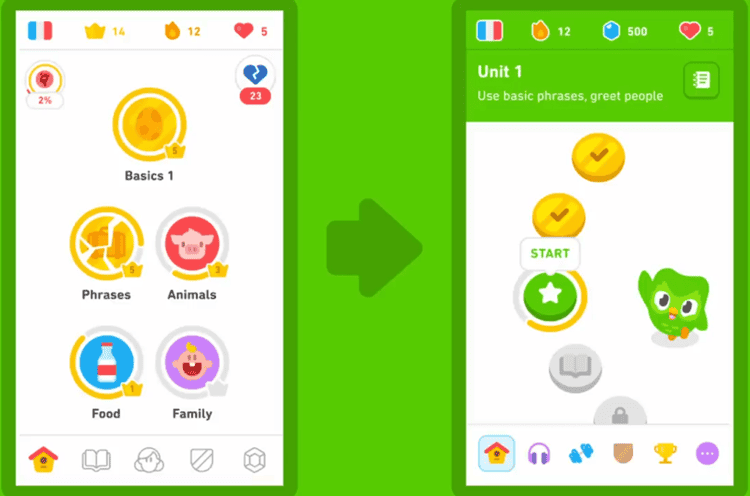
Its mobile-first layout, playful illustrations, and game-like elements are built to engage users across all ages—especially children and casual learners.
Navigation is intuitive, and colorful animations keep motivation high.
For casual learners, it's a fantastic daily language habit-building tool.
However, the app’s repetitive nature may feel limiting for users who’ve advanced past the basics.
TalkPal: Realistic and Adult-Focused
TalkPal’s UI centers around a clean, chat-style interface that mimics texting or messaging platforms.
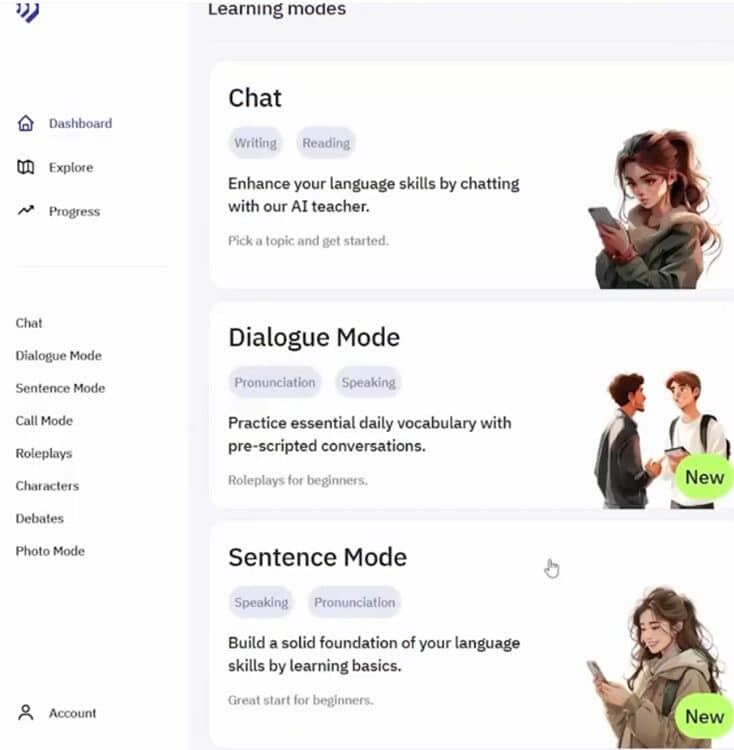
Right from the dashboard, users dive into conversations with an AI assistant, which mimics native speakers.
There’s less gamification and more realism—great for serious learners aiming to simulate real-world dialogue.
Accessibility-wise, both apps offer voice, audio, and text-based input/output elements, though Duolingo may be slightly more beginner-friendly thanks to its visual icons and streamlined navigation.
If you’re considering these apps for young learners, our upcoming guide on language learning apps for kids and teens will provide tailored insight into age-appropriate features.
Performance and Reliability
Both platforms perform reliably across mobile and desktop devices.
Duolingo, given its longer presence and user base, enjoys well-optimized software with minimal hiccups.
Building its interface on years of iteration, it's fast, lightweight, and regularly updated.
TalkPal, while newer, is impressively robust with its proprietary AI engine.
In our testing, voice recognition was accurate even with various accents and background noise.
Responses were near-real-time, making the experience feel like interacting with a real tutor.
One technical consideration is battery usage.
TalkPal’s constant voice input/output functions consume more power than Duolingo’s minimal animations and short sessions, making Duolingo more suitable for on-the-go learning when conserving battery life is essential.
Pricing and Plans
Both apps offer free tiers, but they differ in value.
Duolingo
- Free Plan: Access to all standard features, ad-supported, and limited by a “heart” system
- Super Duolingo: $6.99/month, ad-free experience, unlimited mistakes, and additional review activities
- Family Plan: $9.99/mo for 6 users—a great option for households or classrooms
With minimal costs, Duolingo delivers solid long-term value, especially for those testing multiple languages.
TalkPal
- Free Plan: 10 minutes of AI practice per day
- Premium: $14.99/month or $6.25/month for a 24-month plan
- 14-Day Trial: No credit card required
TalkPal clearly targets dedicated learners—those aiming for fluency via regular speaking practice.
While costlier, it could justify its price through its personalized corrections and virtually unlimited conversations.
Pros and Cons
Duolingo
Pros:
- Engaging design and gamification
- Perfect for casual and new learners
- Affordable pricing
- Large variety of languages
- Good supplementary materials (Stories, Podcasts)
Cons:
- Limited speaking practice
- Doesn’t scale well to advanced learners
- Ad interruptions unless upgraded
TalkPal
Pros:
- Excellent fluency-focused method
- Strong AI feedback and pronunciation tools
- Realistic roleplay scenarios
- 57+ language support
- Very effective speaking/listening training
Cons:
- Free version is limited
Use Cases

Duolingo works best for:
- Absolute beginners
- Casual daily learners
- Kids and families
- Those learning multiple languages simultaneously
TalkPal shines for:
- Intermediate to advanced learners
- Professionals preparing for presentations or relocation
- Users who want real conversation practice
- Travelers aiming for situational prep
Educators interested in integrating these into lessons should stay tuned for our feature on language apps in digital classrooms.
Building on those use cases, let’s further explore how Duolingo and TalkPal stack up in a few targeted learning situations that matter most to current users.
Duolingo vs TalkPal for Specific Learning Scenarios
Learning a Language from Scratch: Which App Handles Beginners Better?
If you're starting a language from zero, the approachability of the platform makes a major difference—and this is where Duolingo clearly shines.
Duolingo’s linear curriculum, visual-heavy interface, and game-like pacing are structured to guide users through bite-sized lessons in alphabets, foundation grammar, and essential phrases.
The app’s lack of pressure makes it ideal for overcoming the initial intimidation of learning a new language.
TalkPal, though incredibly strong for practicing output, can be less intuitive for true beginners, especially those unfamiliar with basic grammar rules or vocabulary in their target language.
Jumping straight into conversation simulations may be jarring without preliminary instruction, unless paired with additional resources.
✔ Verdict: For first-time learners and self-starters, Duolingo is the more supportive starting point.
Conversation Practice & Pronunciation: Which App Excels?
This is TalkPal’s domain.
If your primary goal is improving real-time speaking, listening, and fluency, then it outperforms Duolingo by a wide margin.
With access to over 300 roleplay scenarios, real-time pronunciation feedback, and AI that mimics native speakers, TalkPal creates a near-authentic speaking environment.
By contrast, Duolingo does include some speaking exercises, but these are often brief, lack nuanced feedback, and are not central to the learning model.
Users looking to hone pronunciation or gain confidence speaking aloud may find it lacking.
✔ Verdict: TalkPal is the hands-down winner for sharpening speaking and listening skills—especially for intermediate-level users preparing for real-world use.
Business and Career Language Training

For professionals aiming to acquire function-specific vocabulary for presentations, job interviews, or networking in another language, TalkPal offers more practical output training.
Its system includes simulations for career scenarios, term usage in formal/business settings, and adaptive AI that aligns lessons to industries like healthcare, finance, or technology based on user goals.
While Duolingo is great for foundational learning, it currently lacks depth in specialized vocabulary, especially for industry-specific needs outside of general expressions.
✔ Verdict: For career-oriented learners and professionals preparing for global communication, TalkPal provides more tailored tools.
Speed Learning for Travel: Who Gets You Ready Faster?
When time is short—like learning survival phrases for an upcoming trip—both apps offer value, but serve different functions.
Duolingo is useful for memorization of basic phrases, direction words, and small talk through theme-based lessons.
It’s great for travelers wanting a general sense of common interactions, such as ordering food or asking for help.
TalkPal, on the other hand, allows users to roleplay travel scenarios (“checking into a hotel,” “asking for train tickets”).
Because the app focuses on real-time speech, you become more accustomed to responding naturally and promptly—a vital skill abroad.
✔ Verdict: For passive travel prep, go with Duolingo. For real-time interaction readiness, TalkPal is more effective.
Classroom Integration and Educator Use
Educational institutions and teachers might wonder: Can these apps be used effectively in the classroom?
The answer is yes, but use cases differ.
Duolingo offers a dedicated “Duolingo for Schools” program, a free platform that allows teachers to assign lessons, monitor student progress, and even gamify group learning.
It's a great support tool for younger students or beginner-level classes.
TalkPal, while lacking dedicated classroom management tools, is valuable in higher education or adult learning environments.
Educators use it as a speaking lab supplement focused on oral proficiency assessment, particularly in professional programs or ESL settings.
✔ Verdict: Duolingo suits K–12 and general classroom use; TalkPal aligns with advanced learners in small-group or higher-ed contexts.
Language Availability & Regional Variants
When it comes to language selection, both apps cover major options—but with distinct specialties.
Duolingo supports over 40 languages, including rare entries like Welsh, Hawaiian, and Klingon, appealing to hobbyists or heritage learners.
However, its regional dialect options are more limited.
TalkPal currently supports 57+ languages and includes regional variants such as Latin American vs. Castilian Spanish, and Mandarin with options for simplified or traditional scripts.
This makes it a better choice for learners needing culturally contextual variations.
✔ Verdict: TalkPal leads in both language count and support for dialectical variance.
Pronunciation in Tonal Languages (e.g., Mandarin Chinese)
Tonal accuracy is important in languages like Mandarin, Thai, or Vietnamese, where mispronouncing a tone can entirely change a word’s meaning.
Duolingo introduces tonal practice through auditory matching and listen-and-repeat mechanics, but does not give granular tone correction.
TalkPal's real-time pronunciation detection provides tonal feedback, letting users see pitch contours and hear side-by-side correct intonations.
This makes it a superior tool for linguistic precision in tonal and phonemically complex languages.
✔ Verdict: TalkPal stands out for its detailed pronunciation tools in tonal language learning.
Is TalkPal Premium Worth It Compared to Duolingo Plus?
This is one of the most asked questions—and the answer depends entirely on your goals.
- If your priority is maintaining a fun, low-pressure learning routine, Duolingo’s Super plan offers tremendous value at $6.99/month, covering unlimited access across dozens of languages.
- If you’re aiming for conversational fluency, accent accuracy, and real-world roleplay, TalkPal Premium’s $14.99/month plan justifies the price through its immersive output-focused model and AI-driven corrections.
✔ Verdict: Duolingo is the better deal per dollar for casual, long-term learning. TalkPal is worth its premium for those who aim to speak confidently, fast.
Which App Offers Better Long-Term Language Retention?

For retention, consistency is key—and this is where the learning methodology matters.
Duolingo’s spaced repetition system helps reinforce vocabulary over time, but it leans on passive recall and multiple-choice formats, which may not support active language use.
Conversely, TalkPal forces you to actively engage, formulate responses, and correct mistakes in real-time—methods closely aligned with long-term fluency and retention research.
✔ Verdict: TalkPal offers greater potential for sustained language fluency, particularly via active memory engagement.
Unique Selling Points
Duolingo’s strongest appeal is its habit-building structure, powered by its dopaminergic game mechanics.
Meanwhile, TalkPal excels through dynamic output-focused learning, making users communicate, respond, and think in the target language daily.
Each app reflects different philosophies: Duolingo supports input-heavy comprehension development, while TalkPal is tuned toward productive skills and fluency.
Customer Support and Resources
Duolingo provides a comprehensive help center, active forums, and plenty of tutorials.
TalkPal’s newer, but it offers in-platform feedback, personalized recommendations, and fast email support.
Both platforms include FAQs, onboarding walkthroughs, and usage tips.
For those needing certification or formal tracking, Duolingo offers its AI-powered English proficiency test—a budget-friendly alternative to TOEFL, even recognized by universities.
Future Developments

According to their respective product roadmaps:
- Duolingo plans to expand its AI integration across grammar coaching and visual storytelling
- TalkPal has teased upgrades to its conversation engine, including regional dialect support and multi-voice interaction simulations.
These evolutions could reshape the user experience, both in structured learning and fluid dialogue.
Expert Opinion
From a language education specialist’s perspective, both apps offer tremendous benefits.
Duolingo, for over a decade, has removed psychological and financial barriers to language learning.
It excels in routine-building and introducing core vocabulary and grammar.
TalkPal, while less mature, is already an exceptional solution for learners with foundational skills trying to bridge the gap from structured input to spontaneous output.
It’s probably one of the best tools for building speaking confidence.
In my use, TalkPal provided speaking practice that rivaled human tutoring—a remarkable sign of progress in AI-led education.
Head-to-Head Comparisons
| Category | Duolingo | TalkPal |
|---|---|---|
| Best Use Case | Beginner-focused learning | Conversation fluency training |
| Skill Emphasis | Reading, Vocabulary, Grammar | Speaking, Pronunciation, Listening |
| Accessibility | More suitable for kids, global distribution | Better for adult learners and professionals |
| Price Advantage | Lower cost per month | More robust AI features |
| Long-Term Value | Suitable for long-term casual learners | Ideal for serious language goals |
While Duolingo allows daily progress with minimal effort, TalkPal immerses users in situational conversations that push fluency boundaries.
Both shine in different domains of the learning curve.
If your focus is on practicing complex grammar structures, Duolingo may not be enough.
But if your goal is to rehearse real-life conversations before your next overseas trip, TalkPal may be your go-to.
Duolingo
TalkPal
Conclusion and Verdict
So, which app wins the “Duolingo vs TalkPal” showdown?
Use Duolingo if:
- You’re just starting out
- You want a free, easy-to-use system
- You enjoy gamification and mini goals
- You’re dabbling in several languages
Use TalkPal if:
- You’ve already grasped the basics
- You want to speak and sound like a native
- You prefer conversations over drills
- You’re learning for business, travel, or relocation
Ultimately, the best solution may even be to use both platforms in tandem—begin with Duolingo to lay the foundation, then pivot to TalkPal to practice real-world communication.