italki Review for Beginners: Is It Worth Trying?
If you’ve ever kept a Duolingo streak alive for months only to freeze the second a real person spoke to you, you’re not alone.
That’s the wall a lot of language learners hit: plenty of vocabulary recognition, very little conversational confidence.
At some point, tapping correct answers stops feeling like progress and starts feeling like maintenance.
That’s where italki enters the picture.
Instead of promising fluency through gamified repetition, it offers something much more practical: real teachers, real tutors, and real conversations.
In this italki review, we’re looking at whether the platform actually delivers on that promise—and whether it’s worth your time and money compared with other options.
If you’re feeling burnt out on apps, curious about how to learn a language with native speakers, or trying to find a platform that doesn’t trap you in a subscription, italki is one of the strongest names to consider.
This review is based on a hands-on evaluation of the platform experience, lesson structure, pricing model, free tools, and how it stacks up against competitors.
italki Review Summary
italki
italki connects language learners with 4,000+ native-speaking teachers across 150+ languages — no subscription required.
Choose your own schedule, pick a tutor that fits your budget (from $4/lesson), and learn through flexible 1-on-1 lessons or engaging group classes, all from your phone or desktop.
| Category | Score |
|---|---|
| ⭐ Overall Value | 4.5/5 |
| 💰 Pricing Flexibility | 5/5 |
| 👩🏫 Tutor Quality | 4/5 |
| 🌍 Language Variety | 5/5 |
| 📱 Mobile App Experience | 4/5 |
| 🆓 Free Features | 4.5/5 |
| 🧭 Ease of Use | 4/5 |
Overall Verdict: ⭐⭐⭐⭐½ — One of the most flexible, affordable, and diverse language-learning platforms available today.
Key Takeaways
- No subscription required—you only pay for the lessons you book
- Prices range from about $4 to $120 per lesson
- More than 150 languages are available
- You can choose between Professional Teachers and Community Tutors
- Free tools include assessments, quizzes, podcasts, articles, Topics, and Prompts
- Group classes are available alongside 1-on-1 lessons
- The platform works on desktop, Android, and iOS
- Beginner Mode helps first-time learners get started with less friction
What Is italki?
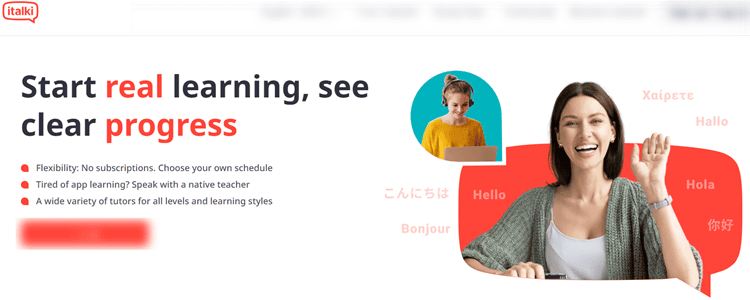
italki is an online language-learning marketplace that connects students with teachers and tutors from around the world.
It offers 1-on-1 lessons, group classes, and several free practice tools.
Unlike many competitors, it does not require a subscription.
You simply create an account, browse tutors, book a lesson, and continue only when you want to.
How italki works
- Create a free account
- Search for a teacher by language, price, availability, and teaching style
- Book a trial or standard lesson
- Take the lesson through italki’s online classroom
- Rebook if the tutor is a good fit
That simplicity is one of the platform’s biggest strengths.
If you want a pay-as-you-go language learning platform, italki is built exactly for that.
Key Features
The biggest headline feature is obvious: access to human language instruction at scale.
But what makes italki stand out is not just the number of tutors—it’s the flexibility around how you learn.
1-on-1 lessons
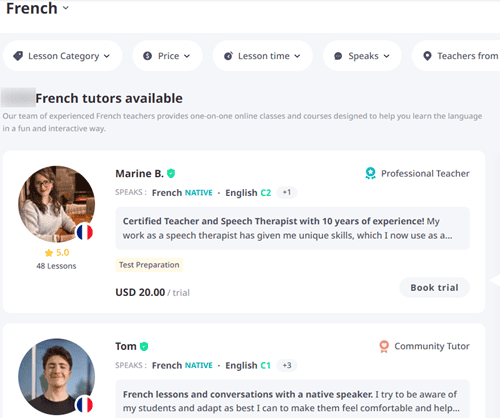
This is the core product.
You can book private lessons with teachers across beginner, intermediate, and advanced levels.
These sessions work well for conversation practice, pronunciation correction, grammar support, exam prep, business language, and cultural coaching.
If you want best online tutoring platforms for language learners, italki belongs in that discussion because the 1-on-1 format gives you a far more personalized experience than an app ever can.
Professional Teachers vs. Community Tutors
italki separates instructors into two categories:
| Feature | Professional Teacher | Community Tutor |
|---|---|---|
| Formal teaching credentials | Yes | Not required |
| Structured lesson plans | Usually | Varies |
| Price range | Higher | Lower |
| Best for | Exam prep, grammar, structured learning | Conversation practice, confidence building |
| Native speaker | Often | Often |
This distinction matters.
If you need structured JLPT prep, business French, or IELTS coaching, a Professional Teacher is usually the better choice.
If you mainly need conversational Spanish twice a week without spending much, a Community Tutor can be excellent value.
Group Classes
italki also offers group learning in two formats:
- Single Classes: one-off sessions
- Group Courses: multi-session programs with a progression
These are often cheaper per session than private classes and work well if you like social learning but still want live teaching.
Free learning tools
A surprising amount of value sits outside the paid lessons.
italki includes:
- Free language assessments
- Podcasts
- Quizzes
- Articles
- Topics for community discussions
- Prompts for writing and speaking practice
That makes it more than just a tutor directory.
It’s not a full curriculum platform, but it does provide enough free support to complement lessons.
italki’s Language Catalog: 150+ Languages
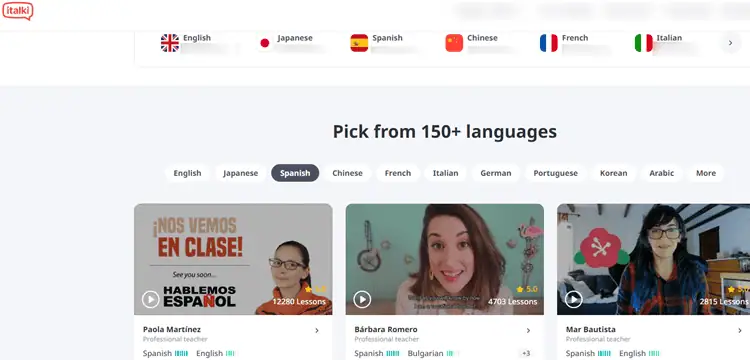
This is one of the clearest reasons italki stands out.
Major languages are well represented:
- English: 4,000+ teachers
- Spanish: 2,000+ teachers
- Japanese: 1,000+ teachers
- French: 1,000+ teachers
- Chinese: 1,000+ teachers
- Italian: 800+ teachers
- German: 700+ teachers
But the more impressive part is the long tail.
italki supports rare and niche languages including Navajo, Ancient Greek, Cornish, Icelandic, Māori, Klingon, Dothraki, and multiple sign languages such as ASL, BSL, and International Sign.
If you’ve struggled to find rare language tutors online, this platform is one of the best places to look.
That breadth also makes it especially useful for travelers, heritage learners, linguistics enthusiasts, and people studying beyond the standard “Top 10” languages.
If a competitor can’t serve your language, there’s a decent chance italki can.
User Experience
The desktop site is clean and practical.
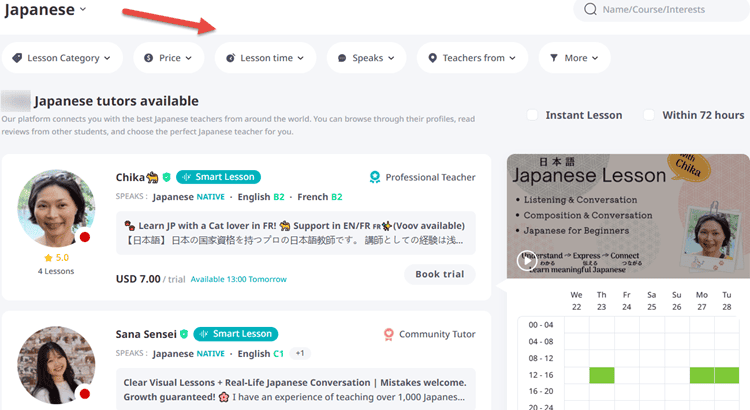
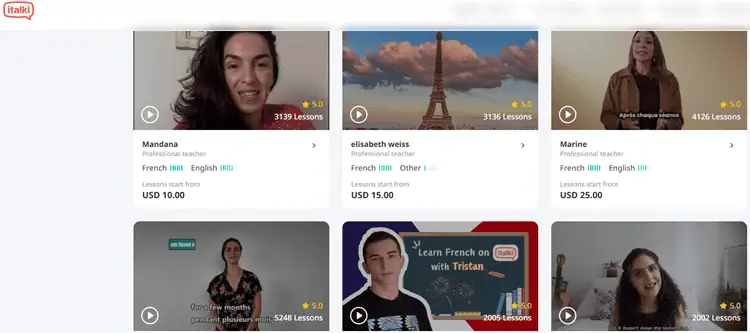
The teacher search interface is one of the better-designed parts of the platform, with filters for language, price, availability, teaching style, lesson type, and teacher category.
A motivated user can usually narrow down a shortlist in under five minutes.
Tutor profiles are also informative.
You can usually see:
- Intro video
- Bio
- Languages spoken
- Ratings and reviews
- Lesson count
- Response time
- Specialties and class offerings
That information helps reduce guesswork, although not eliminate it completely.
We found the intro videos especially useful, because you can often tell very quickly whether someone’s communication style fits you.
Mobile app experience
italki is available on Android and iOS, and the app covers the essentials well.
You can browse teachers, manage bookings, join classes, and use many of the free learning features.
For learners who want language learning apps with live tutors, the mobile experience is solid enough to make it part of a routine.
That said, desktop still feels a bit richer.
Navigation is smoother, profile browsing is easier, and comparing tutors side by side is less cramped.
The app is good; the desktop site is better.
The learning curve is low overall.
The biggest challenge isn’t using the platform—it’s choosing the right tutor from a very large pool.
Performance and Reliability
In general, italki performs reliably.
Pages load quickly, search filters respond well, and the booking flow is straightforward.
We didn’t encounter anything that felt technically confusing or broken during normal use.
That matters, because a tutoring platform should feel frictionless before you even reach the lesson itself.
Video quality depends heavily on your internet connection and the tutor’s setup, which is true for nearly every online tutoring service.
The platform itself is stable, but lesson quality can still vary if either side has poor bandwidth, weak audio, or an unreliable device.
That’s less a flaw in italki specifically and more a reality of live online learning.
What matters is consistency rather than uptime.
Because the platform is a marketplace, the experience depends a lot on the tutor you choose.
Two learners can use the same website and come away with very different impressions.
That’s why it’s worth reading reviews, watching profile videos, and considering a trial lesson before booking a package of sessions.
As a rule, italki works best when treated like a marketplace, not a one-click solution.
The platform itself is dependable.
Your results depend on matching with the right person.
Pricing and Plans
Pricing is one of italki’s biggest strengths.
There is no subscription model.
That alone gives it a major advantage over services that push recurring commitments before you know whether a tutor is right for you.
On italki, you can book one lesson, ten lessons, or none at all after trying the platform.
Typical price ranges
| Tutor Type | Typical Price Range | Best For |
|---|---|---|
| Community Tutors | $4–$25 | Conversation practice, budget learners |
| Professional Teachers | $15–$120 | Structured learning, exams, business language |
| Group Classes | Varies | Affordable live interaction |
| Group Courses | Varies | Multi-session structured programs |
Sample pricing will vary by language and tutor experience.
A Spanish conversation lesson might cost $7–$12 with a community tutor.
A Japanese lesson with a certified teacher may run $25–$45.
Professional business-focused lessons in languages like French or English can climb much higher.
From a value perspective, this is excellent.
You can start small, test different instructors, and spend according to your needs.
Pros and Cons
Pros:
- No subscription required
- Huge language catalog with 150+ options
- Lessons can start as low as $4
- Strong flexibility for scheduling and frequency
- Free features add real value
- Great for beginners, travelers, and conversation practice
- Beginner Mode lowers friction for new users
- Group classes provide another learning format
Cons:
- Tutor quality varies, especially among Community Tutors
- No built-in curriculum across the whole platform
- Advanced learners may need more careful tutor vetting
- App is slightly less robust than desktop
- Group classes are less prominent than private lessons
- Money-back protections are not as prominent as some competitors
Use Cases: Who Is italki Best For?

italki is strongest when flexibility matters more than following a single, rigid curriculum.
Great fit for:
- Absolute beginners: Beginner Mode and low-cost tutors make it easy to start
- Busy professionals: no subscription means you can book around work
- Students: useful for supplementing school or university language study
- Travelers: ideal for conversational prep before a trip
- Budget-conscious learners: community tutors can be extremely affordable
- Niche language learners: one of the best places to find uncommon languages
- App-fatigued learners: a much more human alternative to flashcard-heavy tools
Less ideal for:
- Learners who want a built-in step-by-step curriculum
- Parents wanting a highly specialized kids-only platform
- Users who want the platform to choose the tutor for them automatically
If your goal is conversation, confidence, accent practice, or flexible tutoring, italki is a strong match.
If your goal is a fully managed course sequence, you may need to create that structure yourself or rely on a highly organized teacher.
Common Questions: How Flexible Is italki in Real Life?
One reason italki keeps coming up in conversations about best online tutoring platforms for language learners is that it works well outside the “ideal student” scenario.
You do not need to be taking classes three times a week or following a formal textbook sequence for the platform to be useful.
Can you learn a language on italki without following a formal course?
Yes—but with an important caveat.
italki can absolutely help you learn a language without a formal course, especially if your main goal is speaking practice, listening comprehension, or building real conversational confidence.
Many learners use italki as the human part of a broader routine: a tutor for speaking, plus self-study for grammar, reading, or vocabulary.
The trade-off is structure.
Because italki is a marketplace, not a single curriculum product, your progress depends on how well your tutor organizes lessons—or how well you organize yourself.
If you want a fully guided path, choose a Professional Teacher with a clear plan.
If you want flexibility and conversation, a Community Tutor can still be a great fit.
Is italki worth it if you only take one lesson per week?

For many people, yes.
In fact, one italki lesson per week is a realistic and cost-effective setup.
A weekly lesson gives you regular accountability, live correction, and a reason to keep practicing between sessions.
That can be enough to create steady improvement, particularly if you spend even 10–20 minutes a day reviewing notes, practicing vocabulary, or listening to content in your target language.
If you expect fluency from one lesson alone, that’s unrealistic.
But if you treat the lesson as a weekly anchor, italki offers strong value.
This is especially true for learners who are trying to move beyond apps without committing to an expensive program.
Is italki good for busy professionals with irregular schedules?
This is actually one of italki’s strongest use cases.
Since there’s no subscription requirement, you can book around meetings, travel, shift work, or unpredictable weeks.
That makes it a smart option for professionals who want flexible language tutoring without the pressure of a recurring plan.
It’s also useful for learners across time zones.
With teachers around the world, it’s often easier to find early-morning, late-night, or weekend availability than on more rigid platforms.
Can italki help you prepare for job interviews in another language?
Yes—provided you choose the right teacher.
Many Professional Teachers and some Community Tutors offer support for business language, mock interviews, presentation practice, and industry-specific vocabulary.
If your goal is to prepare for a job interview in another language, you can usually find tutors who will role-play interview questions, correct your phrasing, and help you sound more natural under pressure.
This is one area where being specific matters.
Search for tutors with experience in business English, corporate French, professional Japanese, or your target niche rather than booking a general conversation lesson and hoping for the best.
italki vs. Competitors
| Feature | italki | Preply | AmazingTalker |
|---|---|---|---|
| Language variety | 150+ | 60+ | 70+ |
| Tutor verification | Two-tier system | Background checks, badges | Strict 3% pass rate |
| Mobile app | Good | Good | Good |
vs. Preply
Preply is strong on tutor volume, business learning, and structured matching.
It also offers strong tutor vetting signals and a money-back guarantee on the first lesson.
For more on that side-by-side, see our detailed in-depth look at Preply.
vs. AmazingTalker
AmazingTalker emphasizes tutor quality control, with a strict approval process and a satisfaction guarantee.
That’s attractive if quality assurance is your top priority.
Still, italki generally wins on language variety, community features, and the overall breadth of learning options.
If you’re curious how those differences play out in practice, our detailed look at AmazingTalker is the logical follow-up.
italki is not the most controlled platform in the category, but it may be the most flexible.
Expert Opinion

Our overall take is simple: italki works best for self-directed learners who know why they want a tutor, even if they don’t yet know which tutor they need.
It is not trying to be a game, a school, and an AI app all at once.
It is trying to connect you with real people who can help you speak better, faster, and more naturally.
That focus gives it a real advantage.
There’s something powerful about moving from passive recognition to active use, and few platforms make that shift as accessible as italki does.
The pricing flexibility is excellent, the language range is exceptional, and the choice between professional teachers and community tutors makes the platform adaptable to many goals.
Its weaknesses are also real.
You need to vet tutors carefully.
You may need to build your own curriculum.
And if you prefer tight platform guidance, another service may feel easier at first.
Still, for learners who value freedom, human interaction, and global language access, italki gets far more right than wrong.
Conclusion and Verdict
So, is italki worth it for language learners?
Yes—especially if you want real speaking practice, flexible scheduling, and the freedom to pay only when you actually use the service.
italki is one of the best choices on the market for learners who are tired of app-only study and ready to start using the language with real people.
It’s particularly strong for beginners, budget-conscious learners, busy professionals, travelers, and anyone studying a niche language.
It’s less perfect for users who want a rigid curriculum built for them from day one.
But even there, the right professional teacher can close that gap.
If you want a platform that combines affordability, choice, and genuine conversational practice, italki is easy to recommend.